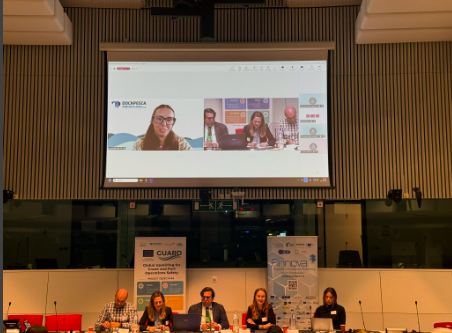
The Erasmus+ project, coordinated by Portugal's DOCAPESCA, brought together workers' and fisheries industry representatives at the European Economic and Social Committee to discuss accident prevention and training in crane operations.
Brussels, 20 October 2026. The European project GUARD, co-funded by Erasmus+, presented its progress and upcoming activities to improve occupational safety in fishing ports on 16 October in Brussels, with particular attention to loading and unloading operations involving cranes and other equipment.
The presentation took place at the European Economic and Social Committee (EESC) during “Building Europe’s Future Skills”, an event organised by Finnova Foundation as part of Erasmus Days 2026. The session brought together representatives of the project consortium, workers and the European fishing industry.
Carla Tabaio, Senior Technical Officer for Communication and Marketing at DOCAPESCA, the project coordinator, presented GUARD's objectives and the initial findings of a questionnaire conducted among fishers from the participating associations. The findings revealed limited training in crane operations and strong interest in improving occupational risk prevention.
Tabaio explained that GUARD will develop specialised training, educational materials, digital resources and informative videos to strengthen the skills of fisheries professionals. The project also foresees training workshops in Portugal and Spain, alongside monitoring and evaluation activities.
Andrea Albertazzi, Senior Policy Officer for Fisheries at the European Transport Workers' Federation (ETF), addressed the risks associated with port operations, particularly in small-scale fisheries. He stressed the importance of appropriate training and qualifications while noting that effective prevention must also take account of working conditions, long working hours and crew fatigue.
Mathilde Nouvel, Project and Communication Officer at Europêche, contributed the European fishing industry's perspective, highlighting occupational safety as an essential skill for fishers. She also emphasised the value of European cooperation and EU-funded projects in developing and sharing effective training approaches.
GUARD brings together four partners from Portugal, Spain and Belgium, including DOCAPESCA, Finnova Foundation and fishing associations from Portugal and Spain. The project aims to reduce occupational risks through practical training, the exchange of best practices and greater awareness of safety in port operations.
GUARD's participation in Erasmus Days 2026 highlighted the importance of adapting vocational training to the practical needs of the fisheries sector and strengthening cooperation between institutions, workers and industry to make European fishing ports safer.